
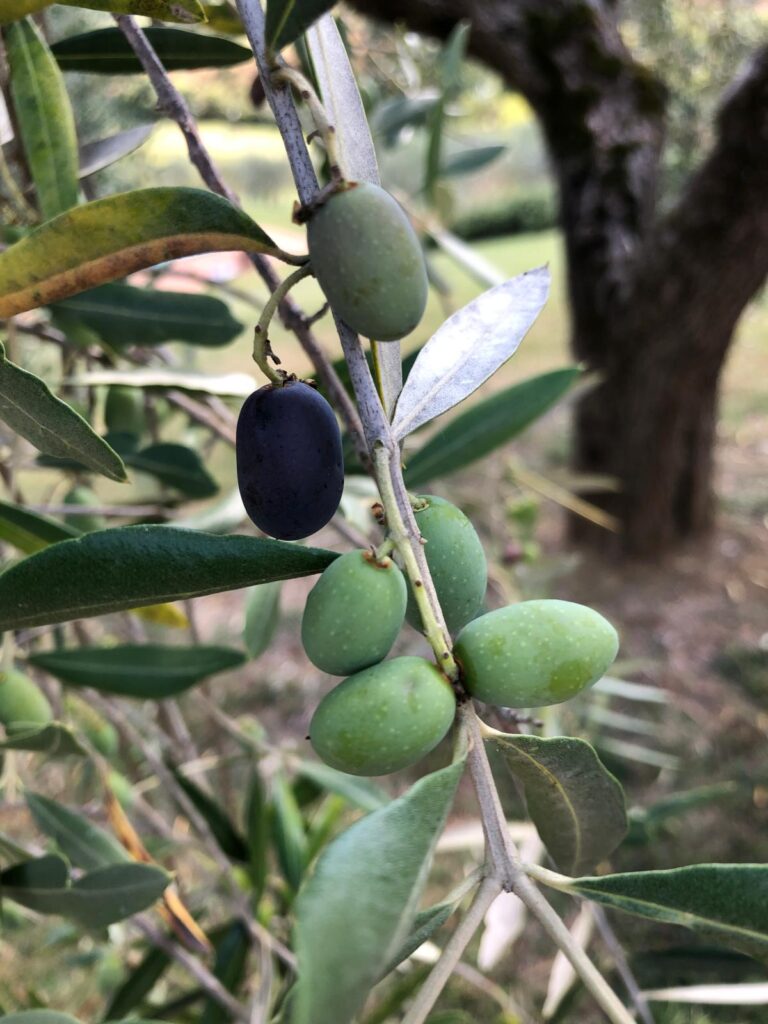
Yet the olive is much more than simply the raw material used to make oil. The properties of the fruit largely determine the aroma, flavour and quality of the resulting olive oil. There are more than a thousand olive varieties worldwide. Only some of them are grown commercially on a large scale. Each variety has its own characteristics and responds differently to the conditions in which it grows. As a result, the same variety grown in different regions can produce olive oils with different flavour profiles.
The variety is not the only factor that matters. The climate, soil, amount of sunlight, availability of water and care of the olive tree also influence the development of the fruit. In addition, harvest time plays an important role. Olives harvested early often produce a different oil from olives picked later.
Early-harvested olives (while they are still green) produce a more intense, fruity oil with a fresh bitterness and a pleasant peppery sensation in the throat. The concentration of phenolic compounds is often higher in early-harvest olive oil, although it also varies according to the olive variety and growing conditions.
Later-harvested olives (when they are riper and darker in colour) produce a fuller, softer and milder flavour.
Although olives are primarily grown for olive oil production or as table olives, not every olive is suitable for both purposes. Some varieties are valued mainly for their oil yield and flavour, while others are selected for their size, texture and suitability as table olives.
Understanding olive oil therefore begins with understanding the olive. In this article, you will learn how an olive grows, which varieties exist and why one olive can ultimately produce a very different olive oil from another.
The Olive Tree
Olives grow on the olive tree (Olea europaea), which has been cultivated in the Mediterranean region for thousands of years. Today, olive trees are also widely grown in South America, Australia, South Africa and parts of North America.
Olive trees are particularly well adapted to hot, dry summers and mild winters. Their root systems and narrow, leathery leaves enable them to survive long periods of drought. At the same time, trees grown to produce high-quality olive oil require careful pruning, fertilisation and, where necessary, irrigation to produce healthy, high-quality fruit.
An olive tree grows slowly and can live for a very long time. Some trees are hundreds of years old, and there are even specimens estimated to be more than a thousand years old. As a tree ages, its trunk develops an increasingly characteristic gnarled appearance, while the tree can often continue to bear fruit.
Olive Varieties
There are more than a thousand registered olive varieties worldwide. Only some of them are grown commercially on a large scale. Many varieties are closely associated with a particular region or even a specific production area.
Well-known varieties include Picual from Spain, Coratina from Italy, Koroneiki from Greece, Arbequina from Spain and Frantoio from Italy. Each variety has its own characteristics. Some produce a mild and delicate olive oil, while others are known for their pronounced fruitiness, bitterness or pepperiness.
Olive oil can be made from a single olive variety (monovarietal) or from a combination of different varieties. In a monovarietal olive oil, the characteristic properties of one variety can be clearly expressed. In a combination, the properties of different varieties can complement one another.
Growth and Ripening
After flowering, small green olives begin to develop. Over the following months, they grow and their composition gradually changes. At the same time, the oil content of the fruit increases.
During ripening, the colour usually changes from green to purple and eventually to dark purple or black. However, colour alone does not reveal everything about ripeness. Even on a single tree, olives may be at different stages of development.
Determining the right harvest time is an important decision for producers. During ripening, both the oil content and the composition of the olive change. Harvest time can therefore affect the oil yield and characteristics such as fruitiness, bitterness and pepperiness. Exactly how these properties change depends partly on the olive variety. Olives harvested later usually provide a higher yield and a softer flavour profile.
Climate and Soil
The character of an olive oil is shaped by a combination of factors. The olive variety forms the basis, but the climate, soil, location of the olive grove and the way the trees are cared for also influence the final quality.
This is why the same variety can taste surprisingly different when grown in different regions. Under different growing conditions, the same variety can produce an olive oil with different aroma and flavour characteristics.
This combination of natural conditions and human choices makes every harvest unique. As with wine, origin and production conditions play an important role in the final character of an olive oil.
Good to Know
An olive does not naturally contain oil as a separate liquid. The oil is held in microscopic droplets inside the cells of the fruit’s flesh. During crushing, the cells are broken open. During malaxation, the small oil droplets can then merge to form larger droplets, making it easier to separate the oil from the water and solid components later in the process.
Sources
- International Olive Council (IOC). World Olive Encyclopedia
- International Olive Council (IOC). World Catalogue of Olive Varieties
- University of California Agriculture and Natural Resources. Olive Production Manual for Oil
- Cecchi, L. et al. (2013). Phenolic profiles, oil amount and sugar content during olive ripening of three typical Tuscan cultivars to detect the best harvesting time for oil production
- Mele, M.A. et al. (2012). Valuable Nutrients and Functional Bioactives in Different Parts of Olive (Olea europaea L.)—A Review