
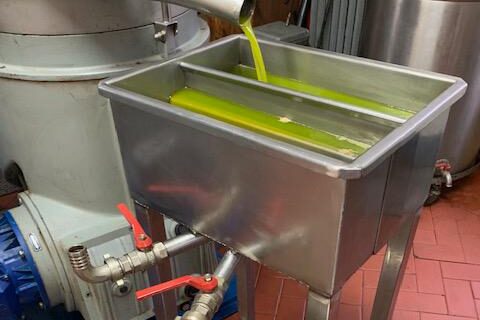
The oil droplets have grown larger during malaxation, but they are still contained within the paste. During extraction, the oil is separated from the other components.
How does a decanter work?
In modern olive mills, extraction is usually carried out using a decanter. This is a long, horizontal metal drum—a type of centrifuge—in which the olive paste spins at high speed. Because oil, water and solid components have different densities, they can be separated from one another. No solvents are involved.
Depending on the type of decanter, two or three separate streams are produced. A three-phase decanter separates the paste into oil, wastewater and a relatively dry solid residue. A two-phase decanter produces two streams: oil and a wet residue containing water and solid components. This system generally requires less process water and produces less wastewater.
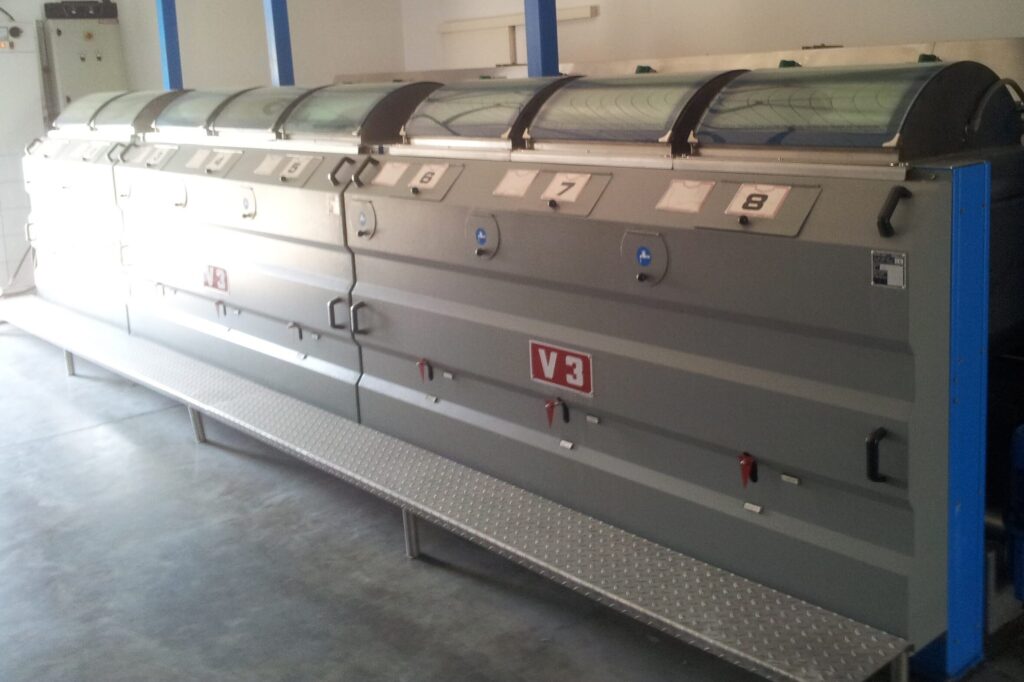
After passing through the horizontal decanter, the oil still contains some water and fine solid particles. These are usually removed using a vertical centrifuge, also known as a separator. The oil can then be clarified further by settling, racking or filtration.
Why is this step important?
Extraction must be carried out carefully. A properly adjusted centrifuge helps separate the oil from the olive paste efficiently. The type of decanter and the extraction settings can also affect the composition and sensory characteristics of the finished olive oil.
The aim is not simply to achieve a high yield, but above all to preserve the quality achieved during harvesting, crushing and malaxation.
Good to know
‘Cold pressing’ and ‘cold extraction’ do not mean the same thing. In cold pressing, the olive paste is compressed using a traditional press. In cold extraction, the oil is separated from the paste rather than pressed; in modern olive mills, this is usually done using a centrifuge. These terms may appear on the label of extra virgin or virgin olive oil only if the oil was obtained at a temperature below 27 °C. Read more on the page Cold extraction or cold pressing.
Sources
- International Olive Council (IOC). (2006). Quality Management Guide for the Olive Oil Industry: Olive Oil Mills
- UC Davis – Food Quality. Olive Oil Processing
- Di Giovacchino, L. et al. (2001). Natural antioxidants and volatile compounds of virgin olive oils obtained by two- or three-phase centrifugal decanters
- European Commission. (2022). Commission Delegated Regulation (EU) 2022/2104, Article 10