
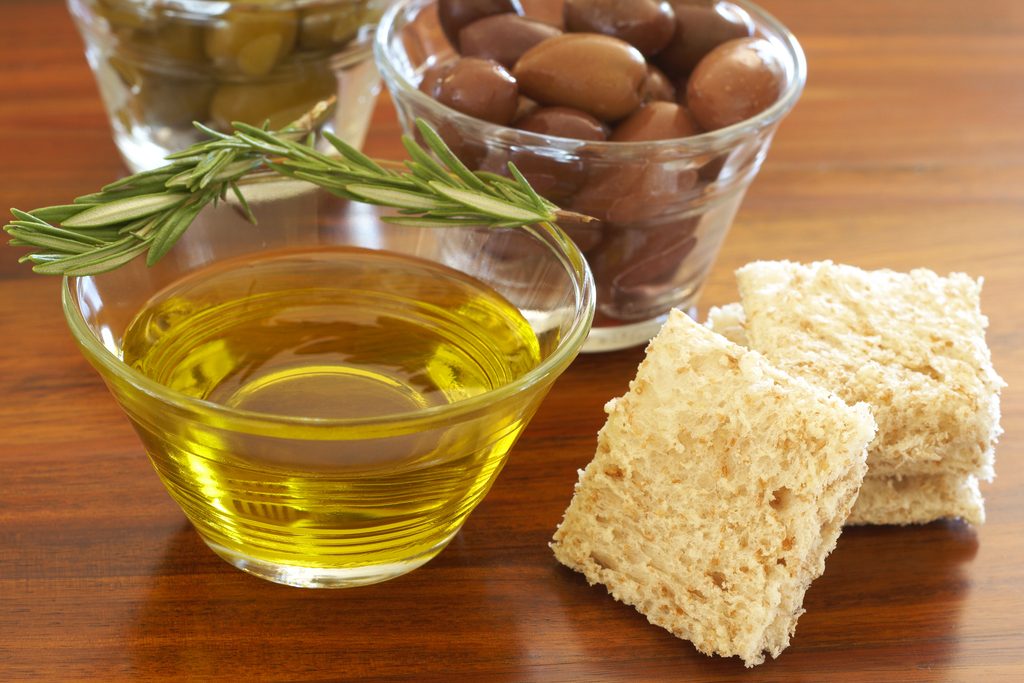
The expression ‘liquid gold’ is often attributed to the Greek poet Homer. Publications that make this claim, however, do not cite a specific passage from his work. Whether Homer actually used these words is therefore difficult to verify.
The expression is understandable, though. In antiquity, olive oil was a valuable and versatile product. People used it as food, as fuel for lamps, for personal care and in rituals. But what exactly is olive oil, what does it contain and how is it made?
Oil from a Fruit
Olive oil differs from many other vegetable oils in its source. The olive is a stone fruit, and the oil is found mainly in its flesh. Sunflower oil, rapeseed oil and soybean oil, by contrast, are extracted from seeds.
Virgin olive oil is obtained directly from olives. At the olive mill, the fruit is washed, crushed and malaxed. The oil is then separated from the water and the solid parts of the olive. Modern olive mills usually use centrifuges for this.
The oil is not subsequently refined. Refining is part of the production of many other vegetable oils.
Read more about the different types of olive oil →
How Is Olive Oil Made?
Several steps lie between the olive on the tree and the oil in the bottle. Each step can affect the final quality.
- The olives are harvested.
- They are taken to the olive mill. There, leaves, twigs and dirt are removed, and the olives are washed.
- The olives are crushed into a paste.
- The paste is slowly malaxed so that small oil droplets can come together.
- The oil is separated from the water and the solid parts of the olive.
- The oil may be filtered.
- It is then stored and eventually bottled.
Care and speed matter throughout this process. Keeping the time between harvesting and processing short reduces the risk of damage, fermentation and other unwanted changes. There is, however, no fixed number of hours that guarantees the same quality in all circumstances. The condition of the olives, the temperature and the way they are transported and stored also play a role.
Follow the complete production process →
More Than Just Fat
Olive oil consists almost entirely of fat. Most of it consists of triglycerides: fat molecules made up of different fatty acids. Olive oil contains mainly unsaturated fatty acids. The most important of these is oleic acid, a monounsaturated fatty acid.
Virgin olive oil also contains small amounts of other naturally occurring substances. Phenolic compounds help protect the oil against oxidation and can contribute to bitterness and pungency. Pigments affect its colour. Volatile compounds are readily released from the oil and partly determine what we can smell.
These substances occur in much smaller amounts than the fats, but they can affect aroma, flavour, colour and shelf life. The exact composition varies between olive oils and can change during processing and storage.
More about the composition of olive oil →
Which Countries Currently Produce the Most Olive Oil?
Olive oil is produced in both the northern and southern hemispheres. Even so, by far the largest share still comes from countries around the Mediterranean Sea.
According to the International Olive Council’s November 2025 estimate, the top five producers for the 2025/26 crop year are:
- Spain – approx. 1,372,000 tonnes
- Tunisia – approx. 450,000 “
- Italy – approx. 300,000 “
- Türkiye – approx. 290,000 “
- Greece – approx. 220,000 “
The order can change from one crop year to the next. Weather, drought, diseases and pests affect the size of the harvest.
Sources
- International Olive Council. (2026). Trade Standard Applying to Olive Oils and Olive-Pomace Oils – COI/T.15/NC No. 3/Rev. 22
- International Olive Council. (2025). Key Figures on the World Market for Olive Oils – 2023/24, 2024/25 and 2025/26
- Jimenez-Lopez et al. (2020). Bioactive Compounds and Quality of Extra Virgin Olive Oil
- Kalua et al. (2007). Olive Oil Volatile Compounds, Flavour Development and Quality: A Critical Review
- International Olive Council. (2006). Quality Management Guide for the Olive Oil Industry: Olive Oil Mills – T.33/Doc. No. 2-4
- University of California, Davis – UC Food Quality. (2023). Olive Oil Quality
- Clodoveo et al. (2014). In the Ancient World, Virgin Olive Oil Was Called “Liquid Gold” by Homer and “The Great Healer” by Hippocrates. Why Has This Mythic Image Been Forgotten?