
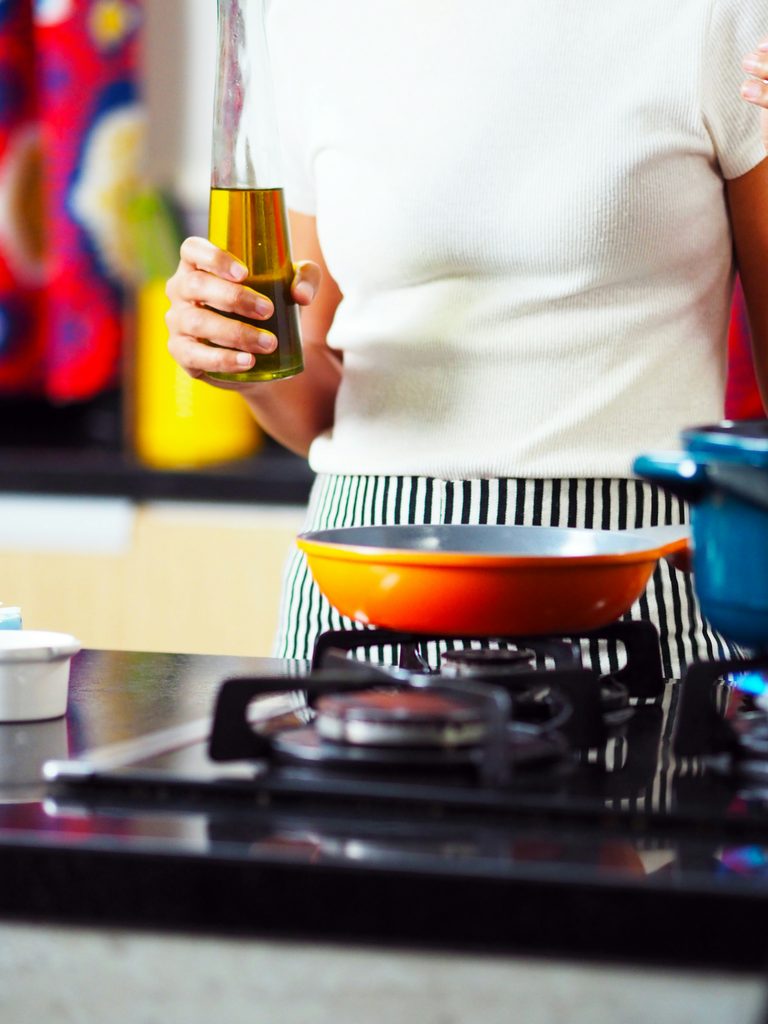
You can use extra virgin olive oil for frying and roasting. Yet there are many misconceptions about heating olive oil. How well it works depends, among other things, on the temperature, how long it is heated, and the composition and quality of the oil.
Can You Fry with Extra Virgin Olive Oil?
The short answer is yes. Extra virgin olive oil is suitable for many everyday cooking methods, including frying, roasting and cooking in the oven.
This is partly due to its fatty acid composition. Olive oil consists largely of monounsaturated fatty acids, particularly oleic acid. These are less susceptible to oxidation when heated than polyunsaturated fatty acids.
Extra virgin olive oil also contains natural antioxidants, including phenolic compounds and vitamin E. These help protect the oil against oxidation. Their amounts vary between oils and gradually decrease during heating.
It is therefore too sweeping to say that extra virgin olive oil should never be heated. Temperature, heating time and the oil’s composition matter more than any single rule.
Is the Smoke Point Really That Important?
The smoke point is the temperature at which an oil begins to smoke visibly under particular conditions. This figure is often used to decide whether an oil is suitable for frying. But the smoke point is not a fixed temperature that is the same for every olive oil.
A 2025 study of several virgin olive oils found that free fatty acid content has a particularly strong influence on the smoke point: generally, the higher the content, the lower the smoke point. Other characteristics of the oil also play a part. Moreover, determining the smoke point partly relies on visual observation.
The smoke point does not tell you exactly how quickly an oil oxidises or which breakdown products form during heating. Factors such as fatty acid composition, antioxidants, temperature and heating time also matter.
The smoke point is relevant, but tells only part of the story. This one figure alone cannot tell you how suitable an oil is for frying or roasting.
Good to Know
Is the oil in the pan beginning to smoke visibly? It is getting too hot. Take the pan off the heat and turn down the heat source. Avoiding unnecessarily high temperatures and long heating times helps limit flavour loss and the formation of breakdown products.
What Happens During Heating?
Every oil changes when heated. Heat and oxygen can cause oxidation and other breakdown reactions. These changes happen gradually rather than suddenly at one particular temperature.
How quickly an oil changes depends on:
- the temperature;
- how long the oil is heated;
- how much oxygen the oil is exposed to;
- the composition and condition of the oil;
- how many times the oil is used.
In extra virgin olive oil, some aroma compounds, phenolic compounds and vitamin E decrease during heating. A study in which olive oil was heated much longer than in normal home cooking nevertheless showed that oleic acid and several other components can remain relatively stable.
Even with shorter cooking methods, such as sautéing, some phenolic compounds can be lost. This does not mean that the oil immediately becomes unsuitable. It shows above all that temperature and time matter. Shorter cooking at lower temperatures generally causes fewer changes than prolonged heating at a high temperature.
Researchers therefore look beyond the smoke point to oxidative stability and the breakdown products formed during heating.
Which Olive Oil Should You Choose?
The olive oil you use depends on more than the cooking method. Taste, price and the dish also matter.
You can use extra virgin olive oil to fry or roast vegetables, fish or meat. It is also suitable for cooking in the oven. A robust olive oil may add a distinct flavour to the dish. If you want the oil’s flavour to be less prominent, choose a milder extra virgin olive oil.
For prolonged deep-frying or repeated use of the same oil, the conditions differ from brief frying or roasting at home. The oil is exposed to high temperatures and oxygen for longer and more often. Its quality therefore gradually declines, as it does with all cooking and frying oils.
A few practical points:
- do not preheat an empty pan or the oil for longer than necessary;
- use no more heat than the dish requires;
- do not let the oil smoke for a prolonged period;
- do not repeatedly reuse oil that has been heated intensely;
- choose an oil whose flavour suits the dish.
Extra virgin olive oil does not have to be used only in cold dishes. It is often a suitable choice for frying and roasting. The smoke point can provide some information, but the oil’s stability depends on several factors.
Sources
- Díez-Betriu A., Quintanilla-Casas B., Masdemont J.J., Tres A., Vichi S. & Guardiola F. (2025). Deciphering the Complexity of Smoke Point in Virgin Olive Oils to Develop Simple Predictive Models
- Lozano-Castellón J., Rinaldi de Alvarenga J.F., Vallverdú-Queralt A. & Lamuela-Raventós R.M. (2022). Cooking with Extra-Virgin Olive Oil: A Mixture of Food Components to Prevent Oxidation and Degradation
- Chiou A. & Kalogeropoulos N. (2017). Virgin Olive Oil as Frying Oil
- Allouche Y., Jiménez A., Gaforio J.J., Uceda M. & Beltrán G. (2007). How Heating Affects Extra Virgin Olive Oil Quality Indexes and Chemical Composition
- Lozano-Castellón J., Vallverdú-Queralt A., Rinaldi de Alvarenga J.F., Illán M., Torrado-Prat X. & Lamuela-Raventós R.M. (2020). Domestic Sautéing with EVOO: Change in the Phenolic Profile