
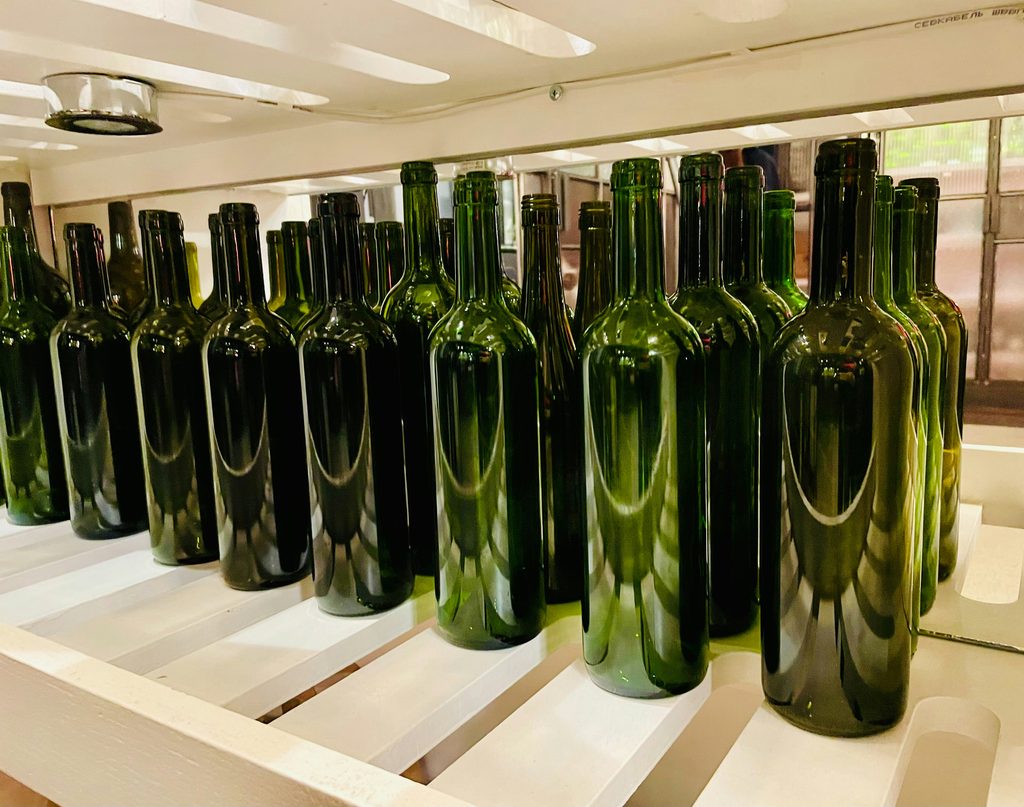
Modern filling equipment helps bottlers control this process carefully, preserving the quality of the olive oil as well as possible.
Why does careful bottling matter?
Olive oil remains sensitive to oxygen, light and heat. The bottler therefore seals each container immediately after filling. This helps protect the olive oil during transport and storage.
What types of packaging are used?
Olive oil comes in different types of packaging, including glass bottles, metal tins and bag-in-box containers. Dark glass and metal tins protect the oil from light more effectively than clear glass. With a bag-in-box, the inner bag collapses as the oil is dispensed. This reduces the amount of air reaching the remaining oil, while the outer box also protects it from light.
The choice of packaging can play an important part in preserving the quality of the oil during storage. Protection from light and oxygen is particularly important.
What does the label tell you?
The label helps you understand what is in the container. First, it states the legal category: the official designation under which the oil may be sold. Examples include extra virgin olive oil and virgin olive oil. Each category must meet its own legal requirements.
The label also includes information such as the net quantity, the best-before date, storage instructions, and the name and address of the business responsible for the information on the label. Extra virgin and virgin olive oils must also carry an indication of origin.

PDO
Protected Designation of Origin
For a PDO, every stage of production, processing and preparation must take place within the defined geographical area. The logo itself only states ‘Protected Designation of Origin’. The protected name elsewhere on the label tells you which area is involved. An Italian olive oil label may, for example, carry the name Terra di Bari DOP.
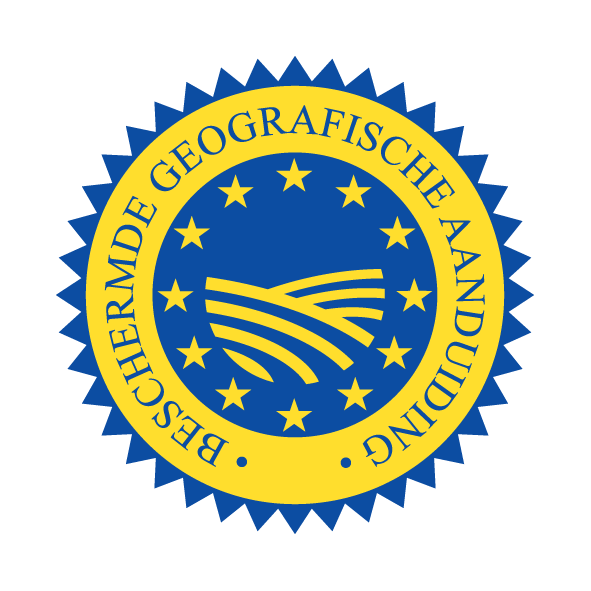
PGI – Protected Geographical Indication
For a PGI, at least one stage of production, processing or preparation must take place within the defined area. Here too, the protected product name tells you which area is involved. Olio di Puglia IGP, for example, refers to the Italian region of Puglia.
[Source of logos: European Commission]
The names and abbreviations vary by language. In English, you will see PDO and PGI. Italian, Spanish and Portuguese labels usually use DOP and IGP, French labels use AOP and IGP, and Dutch labels use BOB and BGA. On Greek labels, you may come across ΠΟΠ and ΠΓΕ. The shape and colours of the European logos remain the same, making them recognisable even if you do not understand the language.
A PDO or PGI logo provides information about protected origin and defined production requirements. It is not a legal category of olive oil.
Take Olio di Puglia IGP as an example. To use this protected name and the blue PGI logo, the oil must comply with the official product specification. This is the rulebook that sets out where and how the oil must be made and which characteristics it must have. The European Commission has published an official summary of this product specification.
Olio di Puglia IGP is subject to stricter rules than the general minimum requirements for a PGI. The olives must be grown and harvested in Puglia. Extraction, storage and bottling must also take place within the region. At least 70% of the olive trees in the grove must belong to varieties listed in the specification, including Coratina, Cellina di Nardò and Ogliarola varieties. The oil must also meet requirements concerning its acidity, phenolic content, fruitiness, bitterness and pepperiness.
The protected name therefore refers to more than a place on the map. It links the oil to the olive growing, production methods and longstanding reputation of Puglia. The logo shows that the oil has been produced in accordance with these verified requirements. It does not automatically mean that the oil tastes better than an olive oil without such a logo.
An indication of origin is mandatory for extra virgin and virgin olive oil. This may refer to a single country or use a broader description, such as ‘blend of olive oils of European Union origin’. If the olives were harvested in one country and processed into oil in another, the label must name both countries.
The name and address on the label do not automatically tell you who grew the olives, made the oil or bottled it. They identify the business under whose name the oil is sold. This business is responsible for ensuring that the mandatory information is accurate. If the business is not established in the European Union, the importer carries this responsibility. Only when the label explicitly states ‘produced by’ or ‘bottled by’ does it also identify the named business with that particular operation.
Statements about production methods are also subject to rules. ‘First cold pressing’ may only appear on extra virgin or virgin olive oil obtained below 27 °C using a traditional hydraulic press.
‘Cold extraction’ may only be used for extra virgin or virgin olive oil extracted from the olive paste below 27 °C by centrifugation or percolation. Centrifugation is the most common method: a rapidly rotating drum separates the oil, water and solid matter. In the less common percolation method, metal plates move through the paste. The oil adheres to the metal and can then be collected. The statement therefore provides information about the production method and temperature, but does not automatically indicate the final quality of the oil.
A best-before date is mandatory, but a harvest year is not. If a harvest year appears on extra virgin or virgin olive oil, all the oil in the container must come from that harvest. The best-before date and harvest year therefore provide different information.
The business responsible for the label determines the best-before date. There is no fixed European time limit. You cannot therefore use this date to establish reliably when the oil was harvested or bottled. To get a better indication of how recent the oil is, look for the harvest year or bottling date, if either is stated on the label.
A label provides valuable information about the oil. Only by tasting it can you discover how it smells and tastes and whether it is free from sensory defects.
Sources
- European Commission. (2019). Olio di Puglia – single document accompanying the application for registration
- International Olive Council (IOC). Quality Management Guide for the Olive Oil Industry: Packing Plants
- UC Davis – Food Quality. Olive Oil Packaging
- European Commission. (2022). Commission Delegated Regulation (EU) 2022/2104: marketing standards for olive oil
- European Union. (2011). Regulation (EU) No 1169/2011 on the provision of food information to consumers
- European Union. (2024). Regulation (EU) 2024/1143 on geographical indications and quality schemes