
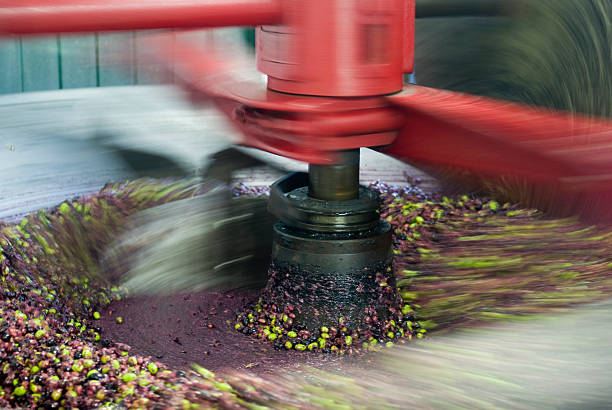
The whole fruit – flesh, stone and skin – is crushed into a smooth olive paste. Crushing breaks open the cells of the olives, releasing tiny droplets of oil. The way the olives are crushed affects both the extraction yield and the flavour and aroma of the final olive oil.
How are olives crushed?
Traditionally, olives were crushed using heavy granite millstones. One or more stones slowly rolled over the olives on a stone base. The flesh, skin and usually the stones were crushed into a paste. The millstones did not press the oil directly from the olives; the oil was separated during later stages of production.
Stone mills work slowly and generally generate little heat. The resulting paste may also be less emulsified, allowing the small droplets of oil to combine more easily during malaxation. There are practical disadvantages, however. Stone mills are large, operate in batches and process fewer olives per hour. They are also more difficult to clean thoroughly. Because crushing takes longer and the paste may be exposed to more air, poor process control can increase the risk of oxidation and unwanted fermentation.
Most modern olive mills therefore use a hammer crusher, disc crusher or another type of metal crusher. These machines are more compact, work faster and can be incorporated into a continuous production line. They are generally easier to clean and allow greater control over the crushing process. Depending on the machine, settings such as the fineness of the paste, the size of the openings in the screen and the rotational speed can be adjusted.
Modern crushing equipment does not automatically produce better olive oil. The type of crusher and the settings used can affect the temperature and structure of the paste, as well as the extraction yield, phenolic compounds and aroma of the oil. Its main advantage is that the process can be carried out more quickly, hygienically and consistently.
Why is proper crushing so important?
Crushing produces a paste in which the oil, water and solid components have not yet been separated. During the next stage – malaxation – the small oil droplets combine to form larger droplets. This makes it easier to separate the oil later in the process.
Temperature control
During crushing, the olive paste can become warmer because of the force and friction involved in breaking up the olives and their stones. This rise in temperature can affect the phenolic compounds and aromas in the final olive oil.
Good to know
The oil and the water naturally present in the fruit are not separated during crushing. First, an olive paste is produced. The oil is separated from the water and solid components during the following stages of production.
Sources
- International Olive Council (IOC). Quality Management Guide for Olive Oil Mills
- Caponio, F., Gomes, T., Summo, C. & Pasqualone, A. (2003). Influence of the type of olive-crusher used on the quality of extra virgin olive oils
- Caponio, F. & Gomes, T. (2001). Influence of olive crushing temperature on phenols in olive oils
- Vossen, P. (n.d.). Olive Oil Production. University of California Cooperative Extension, Sonoma County.