
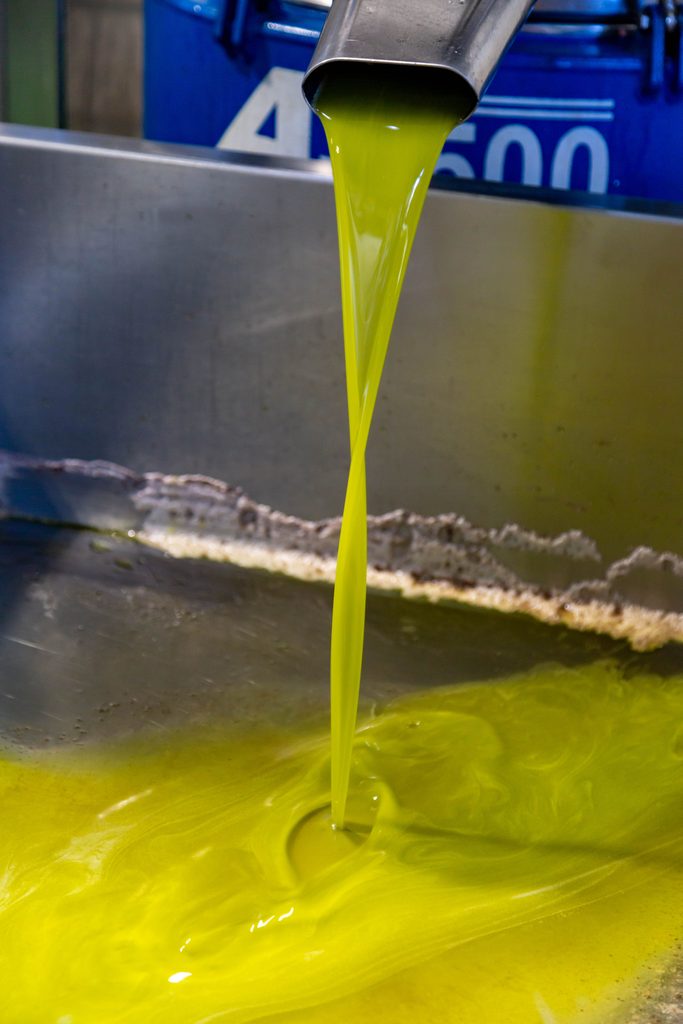
To make the oil clearer and more stable, many producers choose to filter it. Not every producer does so, which is why both filtered and unfiltered olive oils are available.
Why is olive oil filtered?
Filtration removes small water droplets and fine solid particles from the oil. Water and particles left behind can encourage unwanted changes during storage. Micro-organisms, such as yeasts and bacteria, can remain active in the moisture and produce substances that cause undesirable aromas and flavours.
Natural enzymes from the olives may also remain active. Enzymes are substances that speed up certain reactions. As a result, the composition of the oil may change during storage, making it less stable.
Which is better: filtered or unfiltered olive oil?
Some producers choose not to filter their oil. Unfiltered olive oil may look cloudy because it still contains small water droplets and fine solid particles from the olives.
Both filtered and unfiltered olive oil can qualify as extra virgin and be of excellent quality. Filtration therefore does not determine the legal category of an olive oil.
Research into the effects of filtration does not provide a straightforward answer. Filtration may benefit some properties of the oil, adversely affect others or have very little effect. There is therefore no general answer to the question of which is better.
Filtration reduces the risk of changes during storage caused by residual water and solid particles. At the same time, it can also affect some of the natural compounds in the oil.
Phenolic compounds are one example. These natural compounds help protect the oil against oxidation—the reaction with oxygen that can cause oil to deteriorate. Phenolic compounds can also contribute to the bitterness and pepperiness of olive oil.
Filtration may also affect volatile aroma compounds. These compounds are readily released into the air and give olive oil its aroma.
The overall effect depends on the original oil, the amount of water and solid particles it contains, the filtration method used and how the oil is stored afterwards. Filtered olive oil is therefore not always better than unfiltered olive oil. Nor is unfiltered oil automatically fresher or of higher quality.
Good to Know
A clear olive oil has not necessarily been filtered. A producer can also allow the oil to settle. Water and solid particles then sink to the bottom, after which the clear oil is transferred to a clean tank, leaving the sediment behind.
Sources
- International Olive Council (IOC). (2006). Quality Management Guide for the Olive Oil Industry: Olive Oil Mills
- Frangipane, M.T. et al. (2023). Effects of Filtration Processes on the Quality of Extra-Virgin Olive Oil—Literature Update
- Breschi, C., Guerrini, L., Corti, F., Calamai, L., Domizio, P., Parenti, A. & Zanoni, B. (2021). Quality of Veiled Olive Oil: Role of Turbidity Components
- Ngai, C. & Wang, S. (2015). Filter or Not? A Review of the Influence of Filtration on Extra Virgin Olive Oil