
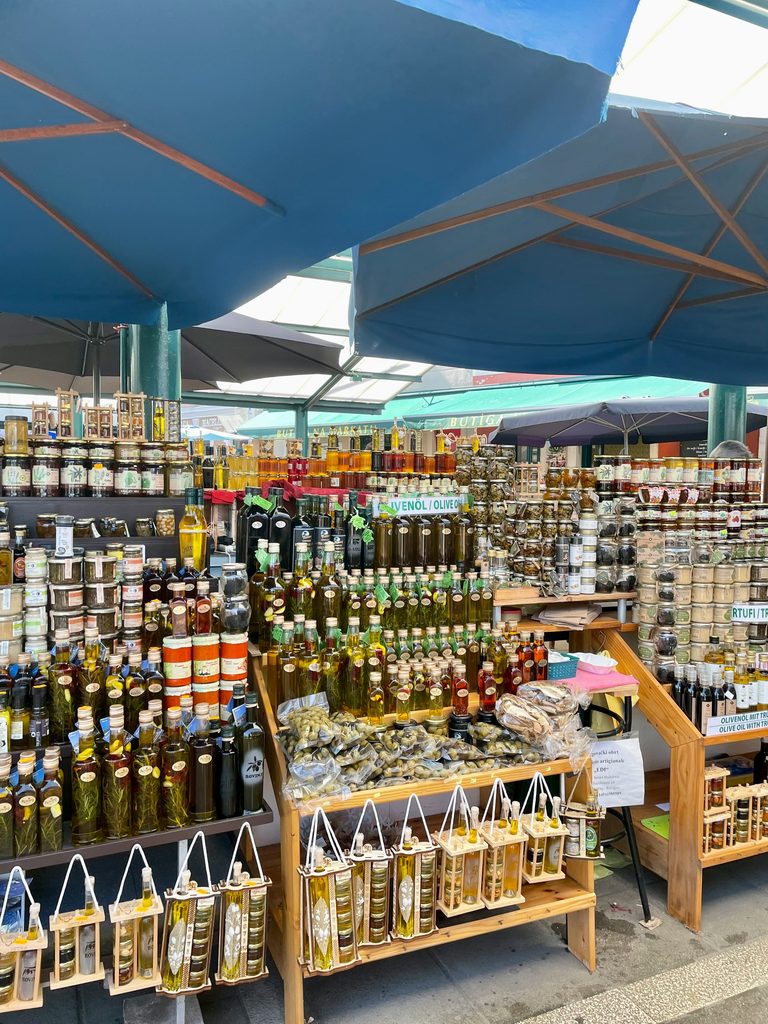
In a specialist shop, you may be able to smell and taste the olive oil. In a supermarket, that is often not possible. An attractive label alone is no guarantee of the quality of the oil inside, but the packaging can still provide useful clues.
This page explains what to look for when buying olive oil and how to protect it at home from its three main enemies: light, oxygen and heat.
Start With the Quality Grade
The label states the quality grade of the oil. Extra virgin olive oil is the highest grade of virgin olive oil. It must meet chemical requirements and be free from defects in an official sensory assessment. Fruitiness must also be perceptible.
“Virgin olive oil” is also obtained directly from olives, but limited sensory defects are permitted. A product labelled simply “olive oil” contains refined olive oil blended with virgin olive oil.
The quality grade tells you which requirements the oil met when assessed. It does not automatically tell you which oil you will like best. Even within the extra virgin category, flavour, fruitiness, bitterness and pungency can vary considerably.
What Does the Label Tell You?
The label can help you choose an olive oil. It provides information about the quality grade, origin, best-before date and sometimes the harvest year. These details offer clues, but do not tell the whole story. Read What does the label tell you? to find out what this information does and does not tell you about the oil.
Which Packaging Protects Olive Oil Best?
Olive oil is sensitive to light and oxygen. Good packaging limits its exposure to both.
Dark glass and metal tins block much of the light. Other types of packaging can also be suitable if they let in little light and oxygen. With a bag-in-box container, the inner bag collapses as the oil is used, so relatively little fresh air comes into contact with it.
Clear glass offers less protection when the bottle is exposed to light. A clear bottle kept in a closed box can, however, be well protected as long as the box is used.
The material is not the only thing that matters. The closure, the amount of air above the oil and where the package is stored also play a part. A tightly closed bottle in a dark cupboard protects the oil better than the same bottle on a sunny worktop.
Why Are Light, Oxygen and Heat Harmful to Olive Oil?
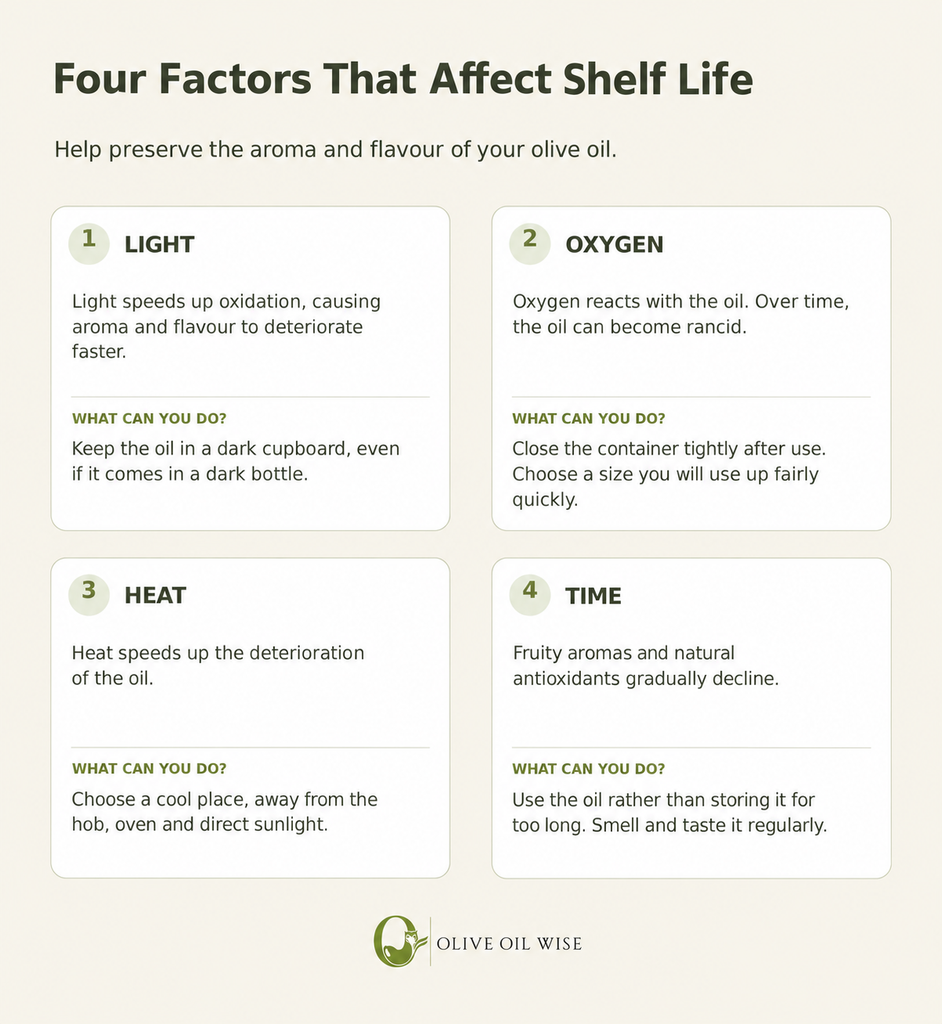
Olive oil gradually changes from the moment it is produced. Exposure to oxygen causes oxidation, and light and heat can speed up this process.
During storage, fruity aromas can fade and bitterness and pungency may become less noticeable. Eventually, a rancid smell or taste may develop. Natural antioxidants also decrease over time.
These changes do not happen at the same rate in every oil. The rate depends, among other things, on:
- the oil’s original quality and composition;
- the packaging;
- exposure to light and oxygen;
- the storage temperature;
- how often and for how long the package is opened.
Research under simulated household conditions shows that protecting the oil from light can substantially slow its deterioration. Limiting exposure to oxygen also helps preserve its quality for longer.
Where Should You Store Olive Oil at Home?
Store olive oil in a cool, dark cupboard if possible. At home, it is particularly important to keep the temperature reasonably stable and avoid exposing the oil to warmth for long periods. Do not leave a bottle near a window, oven, radiator or hob.
Close the package immediately after use. An open pouring spout may be convenient, but it constantly lets air reach the oil. A cap or another tight-fitting closure offers more protection.
Practical points to remember:
- keep the oil in the dark and out of direct sunlight;
- do not place the bottle right next to the hob;
- close the package after each use;
- do not decant the oil into an open or clear carafe without a good reason.
Should You Keep Olive Oil in the Fridge?
For everyday use, refrigeration is usually unnecessary. At low temperatures, olive oil may turn cloudy or partly solid. This is a natural occurrence and does not in itself tell you anything about the oil’s quality or authenticity. The oil becomes liquid again at room temperature.
A cool, dark kitchen cupboard is generally more practical. What matters more than keeping the temperature as low as possible is avoiding prolonged exposure to light, heat and air.
How Long Does an Open Bottle Keep?
There is no fixed period that applies to every open bottle. How long the oil keeps depends on its quality when bought, the packaging, the storage temperature and how often the bottle is opened.
As a practical guide, choose a package you expect to use within a few weeks to a few months after opening. This is not a strict shelf-life limit: some oils retain their quality longer than others. Each time a bottle is opened, fresh air reaches the oil and deterioration may speed up.
The date on the label remains a useful starting point, but use your senses too. Good olive oil smells fresh and may bring to mind grass, herbs, tomato, apple or ripe fruit. If these aromas fade and give way to a flat or rancid impression, the oil has clearly deteriorated.
It is therefore better to buy an amount that suits how much you use than to leave a large package half empty for a long time. As a bottle empties, more air remains above the oil. Choosing a suitable size makes it more likely that you will use the oil while its aroma and flavour are still well preserved.
Packaging Helps, but Is Not Everything
A quality grade, harvest year or protective packaging can help you choose. None of these clues tells the whole story on its own. An attractively packaged oil may be old or dull, while a plain-looking bottle may contain an excellent oil.
Look at the whole picture: the quality grade, available information about origin, date, packaging and conditions in the shop. At home, keep the oil in the dark, tightly closed and away from heat.
Good olive oil will not keep indefinitely, but these steps give it the best chance of retaining its aroma, flavour and quality for as long as possible.
Sources
- European Commission. (2022). Commission Delegated Regulation (EU) 2022/2104 on marketing standards for olive oil
- Gargouri B., Zribi A. & Bouaziz M. (2015). Effect of Containers on the Quality of Chemlali Olive Oil During Storage
- Lolis A., Badeka A.V. & Kontominas M.G. (2019). Effect of Bag-in-Box Packaging Material on Quality Characteristics of Extra Virgin Olive Oil Stored Under Household and Abuse Temperature Conditions
- Lolis A., Badeka A.V. & Kontominas M.G. (2020). Quality Retention of Extra Virgin Olive Oil, Koroneiki cv., Packaged in Bag-in-Box Containers Under Long-Term Storage: A Comparison to Packaging in Dark Glass Bottles
- Alimi S., Rodrigues N., Veloso A.C.A., Cruz R., Khemakhem M., Pereira J.A., Casal S. & Peres A.M. (2025). Influence of Household Conditions on the Shelf-Life and Polyphenolic-Related Health Claim of Cobrançosa Extra Virgin Olive Oil
- Di Giovacchino L., Mucciarella M.R., Costantini N., Ferrante M.L. & Surricchio G. (2002). Use of Nitrogen to Improve Stability of Virgin Olive Oil During Storage
- UC Food Quality, University of California, Davis. (2023). Olive Oil Quality
- UC Food Quality, University of California, Davis. (2025). Olive Oil Myths and Facts