
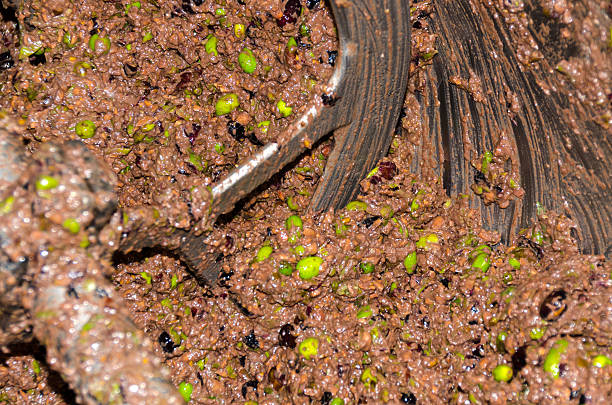
The oil is still dispersed in small droplets. During malaxation, these small droplets merge to form larger ones. This makes it easier to separate the oil during the next stage of production: extraction.
What is malaxation?
Malaxation takes place in a mixing tank fitted with slowly rotating paddles. The olive paste is gently mixed, allowing the small oil droplets to gradually merge into larger ones.
Although this step may appear simple, malaxation helps determine how much oil can be separated from the paste and to what extent aromas and phenolic compounds are retained in the olive oil.
Time and temperature
A longer malaxation time gives the small oil droplets more time to merge, allowing more oil to be separated. At the same time, fresh aromas and certain volatile compounds may be lost.
At a higher temperature, the oil becomes more fluid and can be separated from the olive paste more easily. However, a higher temperature may also adversely affect volatile and phenolic compounds. A higher oil yield therefore does not automatically mean better quality.
Sources
- International Olive Council (IOC). (2006). Quality Management Guide for the Olive Oil Industry: Olive Oil Mills
- Clodoveo, M.L. (2012). Malaxation: Influence on virgin olive oil quality. Past, present and future – An overview
- Angerosa, F., Mostallino, R., Basti, C. & Vito, R. (2001). Influence of malaxation temperature and time on the quality of virgin olive oils